Twin graduation at ECU: Building national security
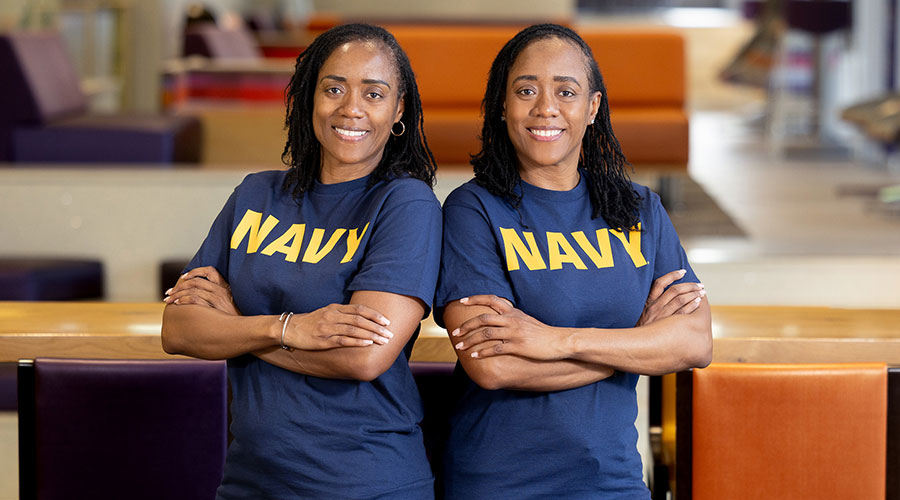
For two U.S. Navy commanders who are twin sisters, East Carolina University has been central to their ambitions to serve the country.
Learn about two ambitious sisters
01/03
For two U.S. Navy commanders who are twin sisters, East Carolina University has been central to their ambitions to serve the country.
Learn about two ambitious sisters
02/03
Kalamazoo College, a private liberal arts school in Michigan, has provided major financial aid to more than 200 students from its hometown over the past decade through an innovative program that offers graduates from Kalamazoo public schools a full scholarship.
Learn about the Kalamazoo scholarships
03/03
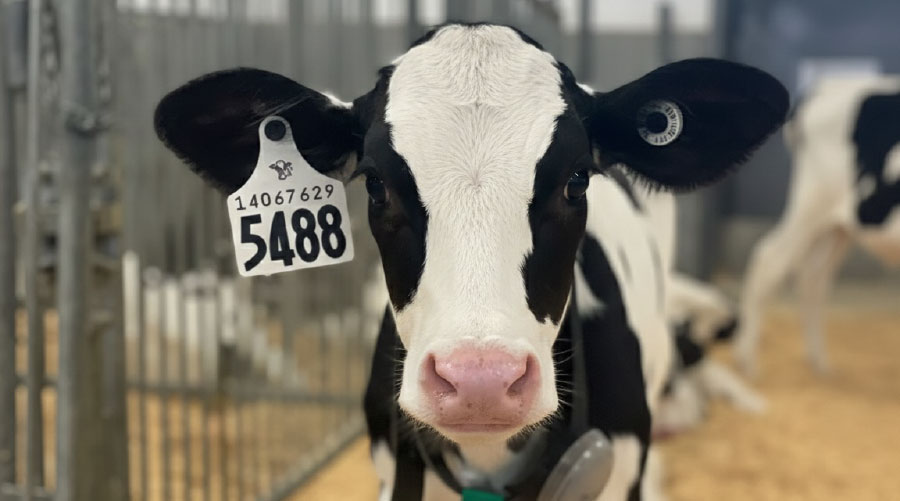
Researchers at Penn State University, the University of Kentucky, and the University of Delaware recently won a $1 million NSF grant to study how devices using artificial intelligence can monitor dairy calves for bovine respiratory disease
Learn about AI and BRD
For two U.S. Navy commanders who happen to be twin sisters, East Carolina University has been central to their ambitions to serve the country.
Brenda and Linda Sharpe, from Pinetops, N.C., graduated in spring 2025 from ECU with doctorates in public health. Years ago, both of them had earned bachelor’s degrees from ECU in environmental health science.
Choosing that field was not random. When the sisters were growing up, their mother worked in a toy factory. They recalled that their mother was exposed to bits of plastic. Worried about such health threats, the sisters resolved to try to prevent them.
“I was tired of seeing my mom come home full of plastic and coughing,” Linda Sharpe says. “I remember I wanted to do something to change this.”
Eventually they became industrial hygienists in the Navy, with responsibility for monitoring safety aboard hospital ships and aircraft carriers. They were able to continue their naval duties while taking courses online from ECU, over a six-year period, to earn their doctorates. Their expertise and leadership are contributing to the safety of our armed forces.
East Carolina University, with about 27,000 students in the city of Greenville, has been building North Carolina and America since it was founded in 1907.
Read more about ECU and the Sharpe sisters at news.ecu.edu.
This is higher education building our national security.
Kalamazoo College, a private liberal arts school in Michigan, has provided major financial aid to more than 200 students from its hometown over the past decade by participating in an innovative program that offers graduates from Kalamazoo public schools a full scholarship.
The Kalamazoo Promise, as the program is known, also supports students who go to public colleges and universities. The Promise has opened up educational opportunity for more than 9,000 public school graduates since it debuted in 2005 with support from private donations. Many of those scholars have gone to Western Michigan University, a public research university based in Kalamazoo, as well as Kalamazoo Valley Community College and others around the state.
Originally, the Promise program focused on providing students with scholarships to cover full tuition and fees at public colleges and universities in Michigan. But a group of private colleges, including Kalamazoo College, joined the initiative in 2015. Those private colleges have provided significant financial aid to help fulfill the Promise.
Since 2015, 230 Promise scholars have enrolled at Kalamazoo College, 40 of whom were first-generation college students. Currently, there are 85 Promise scholars at the college. Known by its nickname “K,” the college has about 1,200 students.
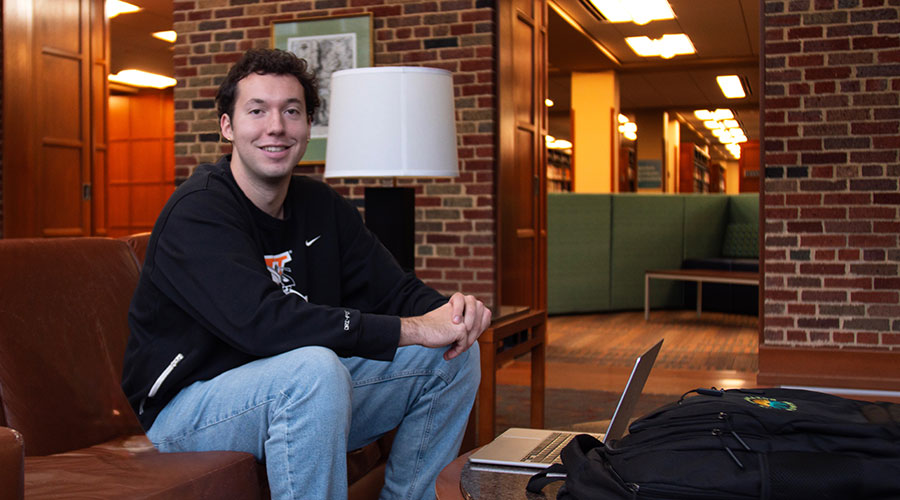
Kalamazoo College student Tom Clark, shown in the picture above, is a junior majoring in business. He is also a Kalamazoo Promise scholar.
Learn more about the Kalamazoo Promise and Kalamazoo College’s participation.
This is higher education building opportunity and community.
Researchers at Penn State University, the University of Kentucky, and the University of Delaware recently won a $1 million National Science Foundation grant to study how devices using artificial intelligence can monitor dairy calves for bovine respiratory disease.
Their experiments, fusing computer science and animal science, could bolster the production of milk. Bovine respiratory disease, a type of pneumonia, is the leading cause of death for dairy calves after they become accustomed to food other than their mothers’ milk, resulting in economic losses of more than $1 billion a year for the U.S. cattle industry. To detect the disease in dairy calves before they show obvious symptoms and reduce those costly losses, the researchers intend to create a system that uses modern sensing technologies and advanced artificial intelligence.
Read about it at psu.edu.
Penn State has more than 85,000 students, the University of Kentucky about 35,000, and the University of Delaware about 24,000. All three were designated as land-grant universities in the 19th century and have been building America ever since.
This is higher education building breakthroughs in modern agriculture.
Higher education is for the nurse monitoring vital signs, and for the patient getting a second chance to live. It’s for the town adding jobs and a reason to cheer and the veteran starting a new chapter.
It’s for you, too—your family, your hometown, your country. Because higher education is right here.
Sign up for campaign updates and stories.